Nutrition-Facts Labels
About sixty years ago, when I was a teenager, I was one of the few people who read food labels. I was taught to do so by my father, Abraham Chuckrow, who was a bacteriologist and chemist and worked as a food inspector. He warned me to avoid foods with artificial color—especially red dye, partially hydrogenated vegetable oil, and bleached white flour. At that time he insisted that the red dye then commonly used for coloring foods would eventually be proven to cause cancer. It was not until decades later that his assertion was borne out.
Recently, a new type of nutritional labeling became mandatory. Almost every food product now has a list entitled “Nutrition Facts” in addition to a list ingredients The purpose is to give the consumer standardized information in a useful, non-misleading form. The older style of nutrition labeling permitted manufacturers the option of contriving a portion size so unrealistically small that calories and salt content appeared to be very low. Previously, if manufacturers made the portion size small enough, even salted peanuts could be permitted to be labeled “low-salt.” Now the portions are standardized so that different products can be compared without a calculator.
Calories From Fat
One of the nutrition facts that appears first is “calories from fat.” Nutritionists frequently advise people to reject foods whose percentage calories from fat is high. Whereas it is beneficial to know the grams of fat and number of calories contained in a food whose fat is valueless, the percentage of calories from fat is not a meaningful number. For example, consider packaged, sliced ham, labeled 97% fat-free. Right now we will not negatively focus on its high salt and nitrate content but only consider fat. A one-slice portion contains a negligible amount of fat (1 g), but the percentage of calories from fat is quite high (33%) because the remaining calories are essentially from protein and, therefore, relatively low. Thus, the percentage of calories from fat is not meaningful. What counts is the amount of fat itself, the calories it provides, and whether that fat is nutritious, non-nutritious, or harmful. Conclusion: Pay no attention to the percentage of calories from fat.
All Natural?
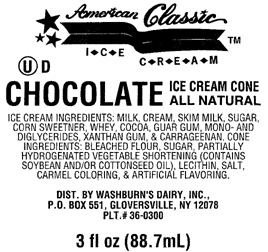
Once you read the ingredients, the characterization “All Natural” on the labels of many foods requires a stretch of the imagination to justify. One such label (below) reveals ingredients that are unnatural (e.g., artificial flavoring) or even harmful (partially hydrogenated vegetable oil).
Other foods that are highly refined and would never occur in nature are portrayed as being 100% natural. For example, the following is printed on a box of Domino¨ sugar: “Sugar is a 100% natural simple carbohydrate. Carbohydrates are an important part of any balanced diet. Sugar contains no fat or cholesterol and has 15 calories per teaspoon.” The first two sentences resemble statements of a logical proof whose conclusion might be: “Therefore, sugar is an important part of any balanced diet.” This conclusion does not follow but would if the second sentence were changed to “Simple carbohydrates are an important part of any balanced diet,” which of course is untrue.
It is interesting to note that “nutrition facts” labels list partially hydrogenated fat content not as saturated fat but, by subtraction, as unsaturated fat:
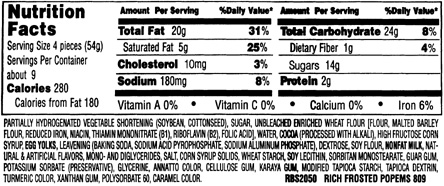
Finally, it should be noted that some labels have self-contradictory information. The following label shows more sugar than carbohydrate, which is impossible because sugar is a form of carbohydrate:
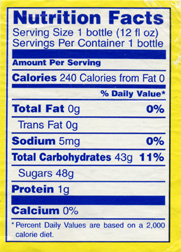
Some errors may not be an attempt to mislead the consumer but simply carelessness on the part of those who provide the information. In any case, do not assume that such information is always correct.
“Natural” Flavors
These days, when an increasing number of people are reading ingredients and rejecting foods with artificial ingredients, manufacturers are able to deceive the public by adding undesirable ingredients under the category “natural flavor.” Natural flavor is supposedly a way of keeping some ingredients secret to prevent competitors from copying their recipes. Unfortunately, natural flavors, which have no nutritional value, include objectionable ingredients such as monosodium glutamate, perfumes, and items to mask undesirable odors in foods by deadening taste buds. Even castoreum—a bitter, orange-brown, odoriferous, oily secretion, found in two sacs between the anus and the external genitals of beavers—is used as a natural flavor in candies, beverages, and deserts! (See http://gentleworld.org/the-gross-truth-about-natural-flavors/.)
The above article is from Robert Chuckrow, The Intelligent Dieter’s Guide, Rising Mist Publications, Briarcliff Manor, NY, 1997, pp. 24–25 and 54–55.
©Copyright 1997 by Robert Chuckrow
More Articles on Nutrition and Health